April 25, 2026 • Maren Solvik • 9 min reading time • Specs verified June 11, 2026
EarthWay 1001-B Seed Plate Quirks: Which Discs Actually Work for Off-Label Crops
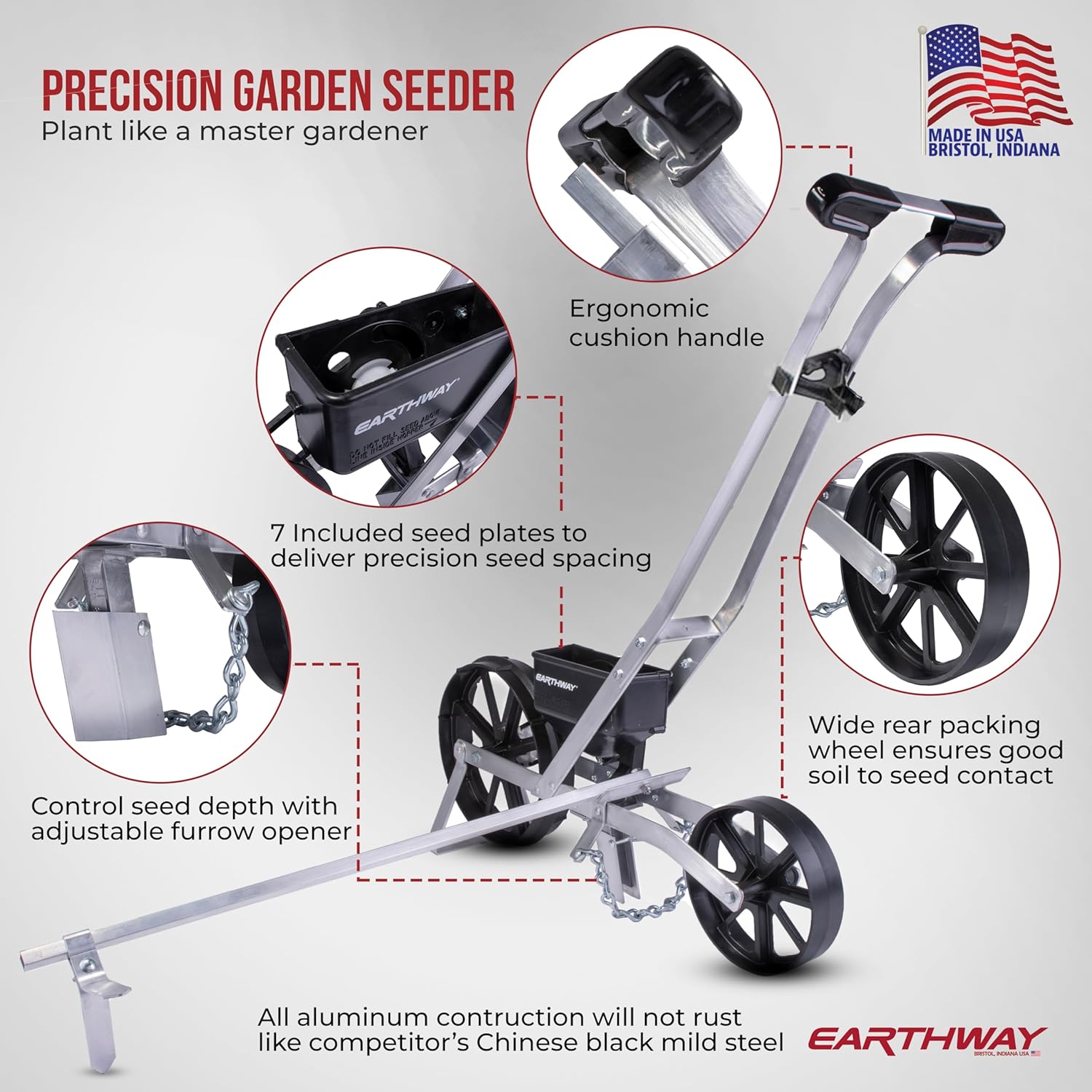
If you’ve just started looking at walk-behind seeders — the wheeled, push-along tools that drop seeds one by one into a furrow as you walk your garden row — the EarthWay 1001-B is probably the first name you’ve encountered. It’s the market’s long-standing “entry into precision” machine: a single-row seeder in the $80–$110 range that uses interchangeable plastic discs (called seed plates) to pick up and drop individual seeds at measurable intervals. Each plate has a different hole size and pattern, designed to match a specific seed diameter and target spacing. The promise is repeatable, hands-free in-row spacing without the wasted seed and uneven stands that come from finger-sowing or broadcasting. That promise is real — but only if the plate you’re using actually fits what you’re planting. This article maps out where the included plates shine, where they quietly fail, and which off-label pairings growers have reverse-engineered to get the most out of this machine.
| EDITOR'S PICK[EarthWay Products 10001 Precisi…](https://www.amazon.com/dp/B00002N66A?tag=greenflower20-20) | Mid-tier[Agri-Fab Push Garden Seeder Pla…](https://www.amazon.com/dp/B0DMTK6D5Q?tag=greenflower20-20) | Budget pick[60009 Set 6 Standard Seed Plate…](https://www.amazon.com/dp/B0CQNJBHBJ?tag=greenflower20-20) | |
|---|---|---|---|
| Seed plates incl. | 7 | 7 | 6 |
| Hopper capacity | — | 3 lb | — |
| Row marker | — | Adjustable | — |
| Compatible models | — | — | EarthWay 1001-B |
| Price | $136.99 | $99.99 | $13.99 |
| See on Amazon → | See on Amazon → | See on Amazon → |
What the Stock Plates Are Actually Designed For (And Where the Map Ends)
The 1001-B ships with six color-coded plates. EarthWay’s own owner’s manual — published and updated by EarthWay Products, Inc. — lists the “official” crop assignments on a printed plate chart tucked inside every box. The standard six cover: large beans and corn, medium beans and peas, beet and Swiss chard, carrot and onion, small-seeded crops like radish and turnip, and a fine-seed plate often used for lettuce.
That chart is a reasonable starting point. But growers who move past the labeled crops — and almost everyone does within a season or two — find that EarthWay’s assignments are conservative and sometimes mismatched to the actual seed geometry of specific varieties. The Rodale Institute’s practical notes on small-farm equipment highlight a consistent theme across walk-behind seeders: manufacturer plate charts are calibrated to average seed size for a crop category, not to the actual measured diameter variation across cultivars and seed suppliers. An ‘Touchstone Gold’ beet seed from one supplier may be noticeably larger or smaller than the generic “beet” assumption baked into the plate.
ATTRA’s resource on organic vegetable production and precision planting makes this point plainly: accurate planting density hinges on matching the plate hole diameter to the actual seed’s largest cross-section, not just crop species. A millimeter of mismatch produces either doubles (two seeds in one hole, wasting expensive seed and creating thinning labor) or skips (empty holes, gaps in your stand).
The core mechanical issue: The 1001-B uses a flat rotating disc with punched holes. As the wheel rolls and the disc turns, each hole passes over the seed hopper, picks up one seed by gravity and mild agitation, then carries it to a drop tube. The hole diameter must be close enough to the seed’s largest dimension to capture one seed — but not so large that two fit, and not so small that the seed jams or skips entirely. EarthWay’s plates offer a limited hole-size ladder. When your crop’s seed falls between two rungs, you’re improvising.
The Off-Label Pairings That Actually Work
This is where the community knowledge accumulated in market-garden circles gets genuinely useful. Growing for Market’s practical comparisons of walk-behind seeders document several off-label plate uses that operators have tested across real growing seasons. Here’s the distilled pattern:
The Beet/Chard plate for spinach: The beet plate (typically a medium-hole disc) is widely reported to handle spinach seed better than any of the stock “labeled” options for spinach, which EarthWay doesn’t formally include in its standard six. Spinach seed is angular and variable — roughly 4–6 mm in its largest dimension depending on variety — and the beet plate’s hole geometry handles that irregularity more forgivingly than the small-seed plate. Operators note occasional doubles with very large spinach seed lots, but the skip rate is substantially lower than forcing spinach through the fine-seed plate.
The Carrot/Onion plate for parsnip and small leeks: Raw (unpelleted) carrot seed is one of the hardest seeds to plate accurately anywhere — it’s tiny, irregular, and lightweight enough to float on agitation air. The carrot/onion plate on the 1001-B is calibrated for raw carrot at roughly 1.5–2.5 mm. Growers using this plate for parsnip report mixed results: parsnip seed is flatter and larger, and the skip rate climbs. However, for small leek seed — which sits in a similar size range to carrot — operators report reasonably consistent results with the carrot plate, especially when the seed lot is fresh (older leek seed shrinks slightly and skips more). Johnny’s Selected Seeds’ seeder resource notes that pelleted carrot seed dramatically improves plate accuracy on this disc, which is worth factoring into your seed budget if you’re growing at scale.
The Large Bean plate for sunflower (short-stem cuts) and large peas: The large-hole plate designed for beans and corn handles sunflower seed with notable reliability for growers producing cut-flower sunflowers at market-garden scale. Sunflower seeds at 8–12 mm fit the large holes without bridging, and the spacing output — typically around 6 inches at walking speed — is usable for single-stem production at tight spacing. Specialty cut-flower producers documented in Growing for Market’s coverage of low-cost seeder setups consistently name the EarthWay bean plate as a workable sunflower option before committing to a dedicated plate or stepping up to a Jang or Terrateck system.
The Fine-Seed plate for shallow-dish herb seed — with caveats: Basil, dill, and cilantro seed are all in the 1–2 mm range and are frequently attempted through the fine-seed plate. The results are crop-specific. Basil seed, being slightly sticky when any moisture is present, clumps and jams this plate with regularity — operators recommend keeping the hopper bone-dry and planting on low-humidity days. Dill works more reliably because the seed is flatter and flows more freely. Cilantro (technically a fruit hull containing two seeds) is inconsistent — you’ll get doubles frequently, which may be acceptable if you plan to thin anyway.
By the Numbers: Hole Size vs. Seed Size on the Six Stock Plates
| Plate | Nominal Hole Diameter | EarthWay’s Labeled Crops | Practical Off-Label Range |
|---|---|---|---|
| Large | ~10–12 mm | Corn, large beans | Sunflower, large peas, fava |
| Medium-large | ~7–8 mm | Beans, peas | Beet (large), Swiss chard |
| Medium | ~4–5 mm | Beet, chard | Spinach, large radish |
| Small-medium | ~2.5–3.5 mm | Carrot, onion | Leek, parsnip (variable) |
| Small | ~1.5–2 mm | Radish, turnip | Dill, small lettuce varieties |
| Fine | ~1–1.5 mm | Lettuce | Basil (dry conditions only), thyme |
Hole diameter estimates derived from EarthWay Products, Inc. published plate specifications and cross-referenced against seed size ranges in Johnny’s Selected Seeds’ crop planting data. Treat as approximations — actual plated accuracy depends on seed lot, moisture, and walking speed.
Where the 1001-B Genuinely Struggles (And What to Do About It)
Pelleted seed is the 1001-B’s best friend and most reliable workaround. Pelleting — the process of coating small, irregular seeds in an inert clay or cellulose shell to create a uniform round pellet — standardizes seed geometry so that any plate calibrated to the pellet diameter performs consistently. Johnny’s Selected Seeds’ seeder guidance and EarthWay’s own documentation both recommend pelleted seed for carrot, lettuce, and onion specifically because the stock plates for those crops were effectively designed around pellet dimensions, not raw seed.
The cost trade-off is real: pelleted seed runs 2–4x the price of raw seed per unit count. The break-even math, for growers seeding more than 200 row-feet of carrots per season, generally favors pelleting because saved seed and reduced thinning labor outpace the pellet premium. For smaller plots, raw seed with accepted imprecision is the economical call.
The skip-rate problem at turns and row ends is a mechanical quirk specific to the 1001-B’s disc design that experienced operators flag consistently. As you decelerate at the end of a row, the disc continues rotating briefly on momentum, dropping extra seeds. At normal walking speed mid-row, skip rates are low on well-matched plates. But growers seeding short beds — under 20 feet — see a disproportionate effect at row ends. The fix is to lift the seeder’s drop tube clear of the soil for the last 6 inches of each row and the first 6 inches of the next, accepting a small unplanted gap rather than a cluster of wasted seed.
Seed hopper agitation is the other persistent complaint surfaced across operator reviews and documented in Growing for Market’s seeder comparisons. The 1001-B’s agitation system — a simple wire wiper inside the hopper — is adequate for round, free-flowing seeds but insufficient for angular or sticky seeds at low fill levels. Keeping the hopper at least one-third full improves flow dramatically. Some operators add a small amount of dry talc or graphite powder (a seed-treating technique noted in ATTRA’s planting resources) to improve flow on sticky seed lots like basil or freshly harvested dill.
Decision Rules: When to Work the Plates, When to Upgrade
The 1001-B plate system rewards patient calibration and punishes hurried planting. Here’s the decision framework that emerges from the research:
If you’re planting 5 or fewer crop types per season and those crops include beans, peas, beets, and carrots — the stock plates will cover you adequately with modest off-label experimentation. The machine earns its keep.
If your mix skews toward small-seeded herbs, specialty cut flowers, or high-value salad crops — budget for pelleted seed on the trickiest species, and accept that 2–3 of your crops will require manual thinning regardless of plate choice. The 1001-B is still a net win over hand-sowing for volume.
If you’re running more than 500 row-feet of a single precision crop — carrots, lettuce, onion — per season, the consistent skip and double rates on the 1001-B’s stock plates begin to cost real money in seed waste and thinning labor. That’s the point where the Jang JP-1 (with its interchangeable roller system offering finer size gradations) or a dedicated vacuum seeder starts returning its higher purchase price. Growing for Market’s market-garden equipment coverage places that crossover for most small commercial operations somewhere between year two and year three of serious production.
The 1001-B is not a limitation — it’s a starting point with a well-documented ceiling. Knowing exactly where that ceiling sits, plate by plate and crop by crop, is what separates the grower who gets consistent stands from the one who blames the seed.