May 25, 2026 • Maren Solvik • 8 min reading time • Specs verified June 11, 2026
Multi-Row Seeders for Salad Mix and Greens: When the Varomorus 5-Row Beats Sowing One Row at a Time
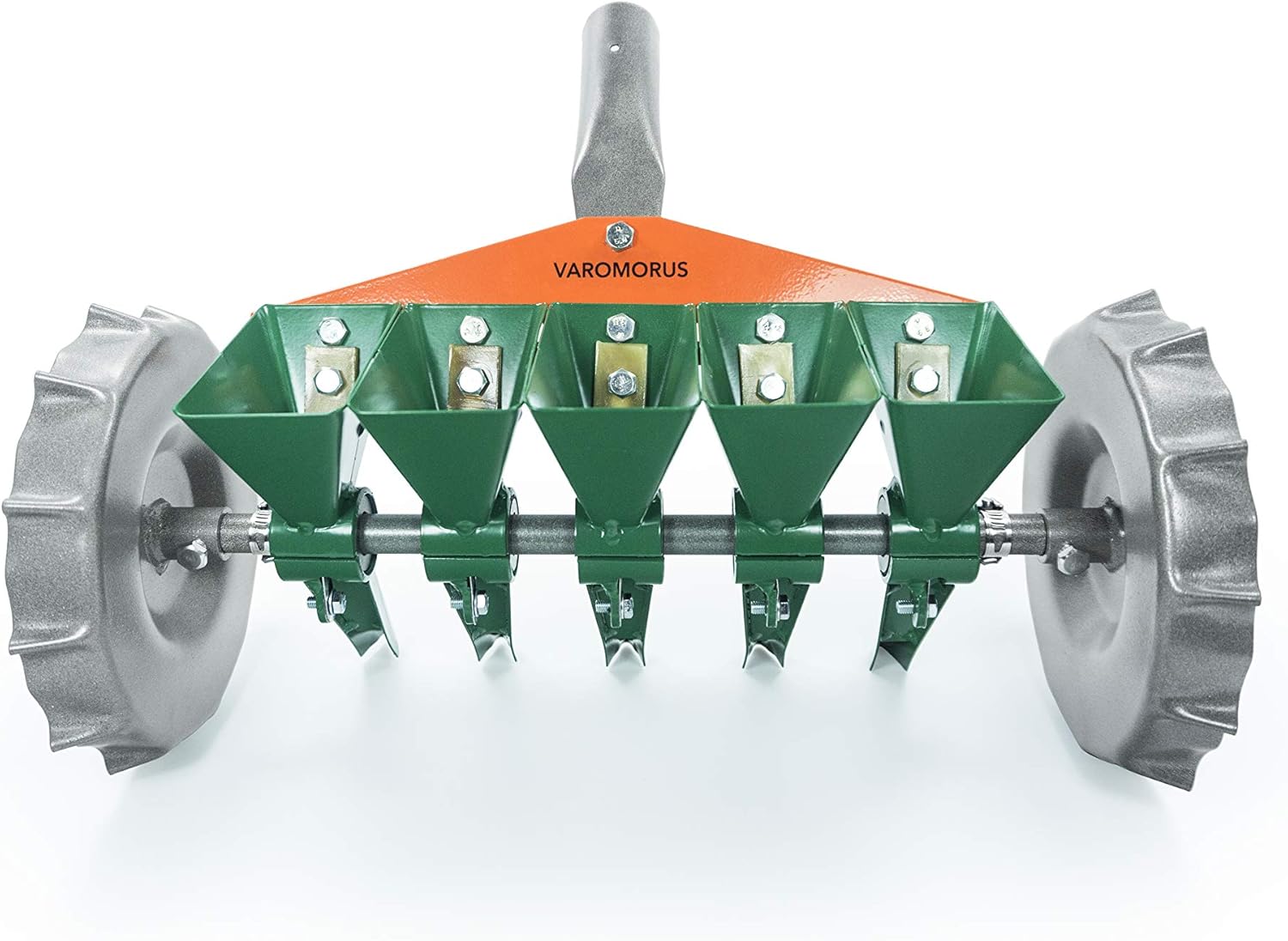
If you’ve ever spent forty-five minutes seeding a 100-foot bed of salad mix one slow pass at a time, you already understand the frustration this article is here to address. A precision seeder is any tool that meters seed from a hopper at a controlled rate — instead of pinching and scattering by hand — so your seeds land at consistent spacing and depth, row after row. A multi-row seeder does that job across several parallel rows in a single pass, the way a small tractor attachment covers ground, but at the scale a person can push through a raised bed or a market-garden plot. The Varomorus 5-Row (sometimes listed as the Varomorus Multi-Row Garden Seeder) is one of the most-discussed tools in this category for small-scale growers. This article explains what makes a multi-row seeder worth its price, where the Varomorus specifically fits in, and — just as importantly — when you’re better off staying with a single-row workhorse like the Jang JP-1 or the Earthway 1001-B.
What “Multi-Row” Actually Means in Practice
A single-row push seeder — the Jang JP-1, the Earthway 1001-B, the Hoss Garden Seeder — seeds one furrow per pass. You push it down the bed, lift and reposition, push again. For crops with wide in-row spacing (transplant-size brassicas, squash, large-seeded beans), that’s perfectly efficient. But salad mix, baby spinach, arugula, and most cut-and-come-again greens are typically seeded in a broadcast or dense-row pattern: multiple rows packed across a 30-inch bed, planted at 1–4 inch in-row spacing, often harvested with scissors before the plants fully size out.
In that scenario, the math on single-row seeding turns painful fast. A 30-inch-wide bed might hold five to seven rows of lettuce or arugula at standard 5-inch row spacing. At a conservative two minutes per pass (including repositioning and aligning the seeder), you’re spending 10–14 minutes on one 30-inch by 25-foot bed. Over a typical CSA greens rotation — say, 20 beds seeded every two weeks — that’s 3–5 hours of seeding time per planting cycle from positioning alone.
A 5-row seeder collapses that to a single pass per bed. That’s the entire efficiency argument, and for greens-heavy operations it’s a compelling one.
By the numbers — single-row vs. five-row at scale:
| Scenario | Passes per 30” bed | Est. time per bed | 20-bed cycle |
|---|---|---|---|
| Single-row seeder, 5 rows per bed | 5 passes | ~12 min | ~4 hrs |
| 5-row seeder, 1 pass per bed | 1 pass | ~3 min | ~1 hr |
| Time saved per 20-bed cycle | — | — | ~3 hrs |
Estimates based on operator benchmarks cited in Growing for Market’s precision seeding overview and consistent with ATTRA’s small-scale vegetable production guidelines.
Where the Varomorus 5-Row Fits — and What Reviewers Actually Say
The Varomorus 5-Row is a pedestrian-push multi-row seeder designed for beds up to roughly 27–30 inches wide, with five individual seed hoppers that can be loaded with the same seed (for a broadcast-style dense planting) or different seeds (for companion rows or a pre-mixed salad blend). The row spacing is typically fixed at the factory — most configurations run around 5–6 cm between rows — though some sellers list adjustable models.
Based on published operator accounts and aggregated reviews across market-garden forums and supplier discussions, a few consistent patterns emerge:
Where operators report it excels:
- Small-seeded greens — lettuce, arugula, mizuna, baby spinach, and similar Brassica/Asteraceae crops — where seed size is uniform enough to meter reliably through the default plates or rollers.
- Beds with consistent, fine-textured tilth. Reviewers repeatedly note that the Varomorus performs best in well-prepared, rock-free seedbeds; stones or clods can throw off furrow depth across all five rows simultaneously, compounding the single-row problem.
- Operators running 10–30+ beds of greens per planting cycle, where the time savings per cycle are large enough to absorb the initial investment.
Where reviewers flag limitations:
- Seed singulation. The Varomorus uses a simpler metering mechanism than a Jang JP-1’s interchangeable roller system. Operators seeding pelleted lettuce or precisely-sized brassica seed for transplant production note less consistent singulation compared to the Jang. For cut-and-come-again mix where exact spacing matters less than uniform coverage, this is a minor concern. For crops where plant-to-plant spacing drives yield (head lettuce, full-size spinach), it matters more.
- Row spacing inflexibility. If your bed layout runs 4-inch rows or 8-inch rows rather than the standard 5–6 cm, you may be working against the tool rather than with it.
- Parts availability. Johnny’s Selected Seeds, Hoss Tools, and Terrateck maintain robust replacement-part inventories for the Jang, Earthway, and their own house-brand tools. The Varomorus parts ecosystem is less formalized as of mid-2026; operators report sourcing replacement seed plates through the original vendor rather than through a U.S. distributor network.
The Jang JP-1 and Earthway 1001-B as the Comparison Baseline
Before committing to a multi-row tool, it’s worth being honest about what a well-dialed single-row seeder can already do.
The Jang JP-1 (roughly $300–$380 depending on roller kit included) is widely considered the benchmark for precision in the single-row push-seeder class. Its interchangeable foam roller system — documented extensively in Johnny’s Selected Seeds’ seeder roller reference chart — allows operators to dial in seed spacing and singulation for an unusually wide crop range. Rodale Institute’s market garden tools overview consistently cites the Jang as a go-to for small-scale commercial production. For crops where precise in-row spacing matters — carrots, beets, large-seeded spinach — reviewers consistently prefer the Jang’s accuracy over simpler mechanisms.
The Earthway 1001-B (roughly $100–$140) offers a lower entry price with a plate-based metering system. Per ATTRA’s sustainable small-scale vegetable production guide, the Earthway is a practical first step for growers who are transitioning away from hand-seeding but aren’t ready to commit to Jang-level investment. Its limitations — less reliable singulation with very small or irregularly shaped seed, occasional bridging in the hopper — are well-documented, and operators typically move past it as bed counts grow.
Neither tool, however, changes the fundamental arithmetic of single-row seeding time on a greens-heavy operation. That’s the Varomorus’s primary value proposition.
The decision rule here is about crop mix, not brand loyalty. If your operation is 60%+ salad greens and baby leaf crops seeded in dense multi-row patterns, the throughput math starts favoring a multi-row tool around 10–15 planted beds per cycle. If your operation is more diverse — roots, alliums, large brassicas — the Jang’s flexibility across crop types tends to win over the Varomorus’s throughput advantage.
Break-Even Math: Does the Varomorus Pay for Itself?
As of mid-2026, the Varomorus 5-Row is typically priced in the $180–$260 range depending on retailer and configuration. Let’s run a straightforward break-even scenario for a small CSA operation.
Assumptions:
- Operator labor valued at $18/hr (common benchmark for owner-operators per SARE’s crop planning guidance)
- 20 beds of greens seeded per planting cycle, every two weeks, 24 weeks of season
- Time saved per cycle: ~3 hours (see table above)
Seasonal labor savings: 3 hrs × 12 planting cycles × $18/hr = $648 in saved operator time per season
At a tool cost of $220, break-even occurs well within the first season — in roughly the first four planting cycles. That math holds even if you haircut the time-savings estimate significantly.
For a home kitchen gardener running 3–5 beds of salad mix, the math reverses. At 5 beds per cycle, the time delta between single-row and five-row seeding is perhaps 25–30 minutes — meaningful, but not enough to justify $220+ over a quality single-row tool at $90–$140. The SARE crop planning framework’s guidance on tool investment scales consistently points toward throughput as the primary justification for multi-row equipment: the tool needs enough volume to exploit its efficiency advantage.
If X, Then Y — The Decision Rules
After working through the specs, the operator accounts, and the break-even math, here’s where the decisions land clearly:
If you’re seeding 10+ beds of salad greens or baby leaf crops per planting cycle, the Varomorus 5-Row’s throughput advantage is real and the break-even is fast. It earns serious consideration as a primary greens tool.
If your operation is mixed — greens plus roots, alliums, and large brassicas — a Jang JP-1 as the primary tool with multi-row seeding as a future add-on is a more defensible investment sequence. The Jang’s roller flexibility across crop types is hard to replicate.
If you’re an Earthway operator at 5–8 beds of greens per cycle, you’re in the upgrade-decision zone but not yet at the throughput level where multi-row seeding is clearly justified. Consider whether adding beds will happen before spending on a new tool category.
If precise singulation matters for your greens — you’re seeding pelleted seed, or spacing matters for full-head lettuce rather than cut-and-come-again — the Varomorus’s simpler metering mechanism is a real limitation. Operators in this situation, per Growing for Market’s production guide discussions, often prefer a Jang even at slower throughput.
If parts availability and long-term serviceability are a purchasing criterion (and for any commercial grower, they should be), the Jang and Earthway both have deeper U.S. parts networks as of 2026. That’s a legitimate tie-breaker if you’re on the fence.
Multi-row seeding isn’t magic — it’s arithmetic. The Varomorus 5-Row is a legitimate tool for the right operation, and the break-even case is honest. The clearest signal is this: count your beds, clock your seeding passes, and let the time math tell you whether you’ve outgrown single-row seeding. Most greens-heavy market gardeners find the answer arrives sooner than they expected.