June 3, 2026 • Maren Solvik • 9 min reading time • Specs verified June 11, 2026
Ergonomic Dibbers and Row Seeders: Cutting Stoop Time Without Spending $400 on a Walk-Behind
If you have ever crouched over a raised bed, index finger punching holes one at a time while your lower back staged a quiet protest, you already understand the problem this article is trying to solve. A dibber is simply a pointed or cylindrical tool you press into soil to make a planting hole — the oldest seeding aid in existence. A row seeder (sometimes called a hand or push seeder) is a wheeled device you walk behind at a comfortable height, depositing seeds at measured intervals as you go. Neither one is a tractor implement or a $400 walk-behind vacuum planter. Both sit in a $15–$120 sweet spot that most serious kitchen-garden growers and small-market farmers skip too fast on their way to the expensive gear — and that’s a mistake worth correcting. This guide maps out who actually benefits from each category, where the ergonomic and precision payoffs are real, and when it genuinely makes sense to keep climbing the price ladder.
Why “Good Enough” Hand Tools Are Costing You More Than You Think
The default approach for most gardeners moving past beginner status is to finger-sow or eyeball spacing with a trowel, accept uneven stands, and mentally file the waste under “learning curve.” But at the scale where you’re running 8–12 raised beds or planting several hundred row-feet of carrots, beets, or lettuce per season, that calculus changes fast.
The ATTRA/NCAT publication “Transplanting and Direct Seeding Vegetables” makes the case plainly: consistent seed spacing reduces inter-plant competition, which is one of the most controllable variables in final yield and uniformity. For crops like carrots that are notoriously difficult to thin, uneven sowing isn’t just an aesthetic problem — it collapses yield per row-foot and drives up labor at harvest. The same document notes that even minimal tooling improvements at the sowing stage pay dividends disproportionate to their cost because errors at germination compound through the entire growing season.
Fine Gardening’s raised-bed tool feature reinforces this point from the home-horticulture angle: growers who switched from finger-sowing to even a basic dibber board or dial-wheel seeder reported more consistent plant emergence and, critically, less replanting. Less replanting means saved seed — and for anyone buying pelleted brassica or pelleted parsley at $0.08–$0.15 per pellet, that matters.
The ergonomic dimension is just as real. Stoop time — the cumulative minutes you spend bent below hip height to place seeds or make holes — is the primary physical cost of hand sowing, and it scales brutally with bed count. This isn’t a comfort preference; it’s a sustainability-of-practice issue. Growers who burn out on planting labor are the ones who start skipping successions or cutting corners on spacing. Good tooling is, in that sense, a growing-system investment, not just a convenience purchase.
The Dibber Spectrum: From $8 Sticks to $60 Ergonomic Boards
A dibber does one thing: makes a hole at a repeatable depth. The variation in price reflects ergonomics, consistency, and throughput — not magic.
Basic T-handle dibbers ($8–$20) are the entry point. A T-grip sitting atop a tapered steel or hardwood spike, typically with depth markings engraved on the shank. The Spruce’s buyer’s roundup consistently names brands like DeWit and Radius Garden as reliable in this tier. Owners report these are perfectly serviceable for transplanting cell-grown starts into beds one at a time, but for direct-sowing dozens of seeds per row, the per-hole motion adds up.
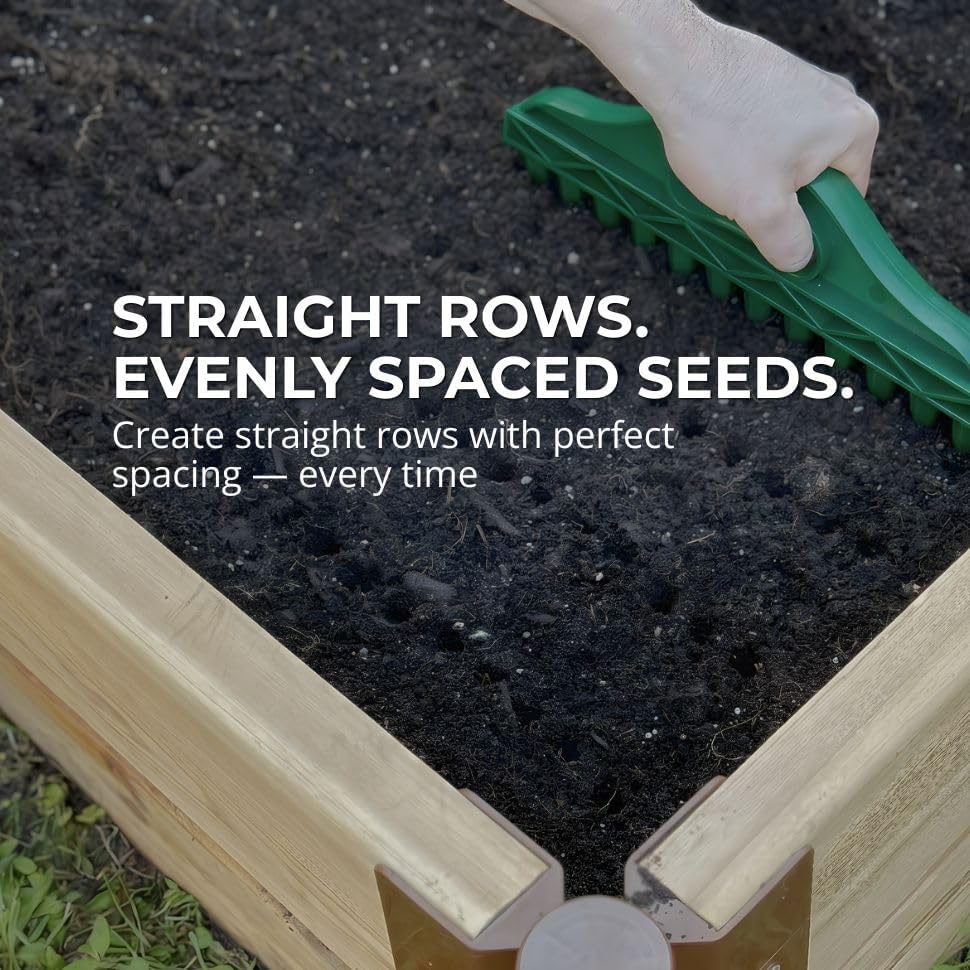
Dibber boards ($25–$55), sometimes called seed boards or spacing boards, are where ergonomics make a visible jump. These are flat boards — often hardwood or HDPE — with a grid of dowel pegs on the underside sized to common spacings (2-inch, 4-inch, 6-inch). You press the board into a prepared bed in one motion and lift it: an entire row or block of holes, perfectly spaced, in under two seconds. Lee Valley Tools offers a well-regarded adjustable version; Johnny’s Selected Seeds stocks a professional hardwood model in their tool catalog that receives consistent positive operator notes in aggregated reviews.
The practical math here is striking:
By the numbers Traditional finger-sowing a 4×8 raised bed at 4-inch spacing (96 holes): ~8–10 minutes, bent at the waist. Dibber board, same bed: ~90 seconds, standing or kneeling briefly. Over 20 plantings per season: ~2.5 hours of stoop time recovered.
Ergonomic long-handle dibbers ($30–$65) solve a different problem: they let you stand nearly upright while placing individual holes, which is particularly valuable when you’re doing transplant work rather than grid-sowing. Radius Garden’s ergonomic dibber and the Wilcox All-Pro model are frequently cited in Fine Gardening and The Spruce roundups for their comfortable grips and durable steel construction. These aren’t speed tools — they’re sustainability tools for growers who are putting in 200+ transplants per week and feel it the next morning.
The honest tradeoff: dibber boards are faster for grid-pattern direct sowing in loose, well-prepared beds. They struggle in heavier, rockier soil where consistent depth is harder to achieve. Long-handle dibbers handle variable soil better but sacrifice throughput. Neither is a substitute for a seeder when you’re placing tiny seeds at precise intervals along a row.
Push Seeders: The Missing Middle Between Dibbers and Walk-Behinds
For row crops — anything you’re sowing in a line at consistent spacing rather than a block — a push seeder is where the real ergonomic and precision gains live at this price tier.
A push seeder is a single-row wheeled device, typically with a hopper for seed, a metering mechanism (dial plate, brush wheel, or pinch wheel), a furrow opener, a covering mechanism, and a depth gauge. You walk behind it at standing height, and seeds drop at intervals determined by the plate or roller setting. The entire category spans roughly $30 (basic dial seeders like the Earthway Precision Garden Seeder’s entry configs) to $120 for more refined models.
The Earthway 1001-B is the benchmark tool in this range. Growing for Market’s back-issue feature on small-farm tools describes it as the workhorse of the category for a reason: available seed plates cover a wide range of crop sizes, replacement plates are easy to source, and the basic mechanism is simple enough to clean and adjust in the field. Owners consistently note it handles medium and larger seeds — beets, beans, corn, larger lettuce pelleted seed — reliably, but that fine seeds like carrots can skip or double-drop without dialing in the plate gap carefully.
The Johnny’s Selected Seeds seeder lineup (their push seeders are sourced from multiple manufacturers and sold under their branding) expands on this with seeders that include brush adjustments for finer seed metering. Their catalog notes, and operators in long-run reviews confirm, that the brush gap is the variable most growers underestimate — a brush set too loose doubles your seeding rate and wastes pelleted seed; too tight and you get skips that cost you stand density.
Where push seeders genuinely beat the Jang JP-1 for your use case:
If your operation is 8–20 beds of mixed vegetables, you’re doing 1–4 successions of most crops, and you’re not running 1,000+ row-feet of any single crop per planting, a good push seeder at $60–$120 almost certainly has a better return profile than jumping to the Jang JP-1 (~$275–$325 depending on roller package). The Jang’s roller system is genuinely more precise and handles a wider seed-size range with less fiddling — but that precision matters most when you’re running the same crop repeatedly at high row count. Rodale Institute’s field bulletin on organic seed starting explicitly notes that metering consistency has the highest payback when seed cost per unit is high (pelleted brassicas, pelleted herbs) and when stand uniformity directly affects harvest mechanization or CSA pack uniformity. If neither condition applies strongly to your situation, the push seeder math holds.
The tradeoffs to name explicitly:
| Scenario | Better tool |
|---|---|
| Mixed crops, <500 row-feet/planting, varied seed sizes | Push seeder ($60–$120) |
| Single crop, 500+ row-feet, high seed cost | Jang JP-1 or equivalent |
| Block-grid transplanting, standing ergonomics priority | Long-handle dibber ($40–$65) |
| Grid direct-sowing in loose raised beds | Dibber board ($25–$55) |
Making the Decision: If X, Then Y
Here is where this tier of grower usually gets stuck — caught between “the basic tool is limiting me” and “the expensive tool feels like overkill.” The decision framework is actually cleaner than it looks.
If your primary pain is stoop time during transplanting, a long-handle ergonomic dibber ($40–$65) solves the specific problem without buying capability you don’t need. This is a legitimate stopping point for growers with up to 10–12 beds who are primarily moving transplants from trays to beds.
If your primary pain is speed and consistency of direct sowing in rows, a push seeder is the right move, and the $60–$120 range is where to shop. Start with the Earthway 1001-B or its direct competitors unless you know you’re running high-value fine seed regularly — in that case, stretch to a model with an adjustable brush mechanism from the Johnny’s catalog.
If you’re already running a push seeder and still losing stand uniformity, before spending $300+ on a Jang JP-1, audit your soil prep. The ATTRA/NCAT direct-seeding guide is unambiguous: mechanical seeders perform to their rated precision only in properly tilled, rock-free, clod-free seedbeds. A $300 precision seeder in a rough bed will perform worse than a $70 push seeder in a properly prepared one. Eliminate the soil variable first.
If your seed cost per planting is exceeding $15–$20 in pelleted seed, run the break-even math honestly. A 15% reduction in wasted pelleted seed from a more precise metering system — which is a reasonable expectation based on the Jang JP-1’s documented metering consistency in Growing for Market’s field reports — starts paying back a $300 tool in fewer than two seasons at that seed spend. That’s when the upgrade makes mechanical sense.
If none of the above is your constraint — if your bottleneck is something else entirely, germination temps, soil moisture, variety selection — no seeder upgrade solves it. The tool is only as good as the system it sits inside.
The dibber and push seeder tier is not a consolation prize while you save up for the walk-behind. For a substantial slice of serious kitchen-garden and small-market operations, it is the right answer, full stop. The discipline is being honest about which problem you’re actually trying to solve before reaching for the next price bracket.