May 7, 2026 • Maren Solvik • 10 min reading time • Specs verified June 11, 2026
Walk-Behind Row Seeders from $100 to $565: Hoss, Chapin, Varomorus, and the Agri-Fab Compared on Spacing Accuracy
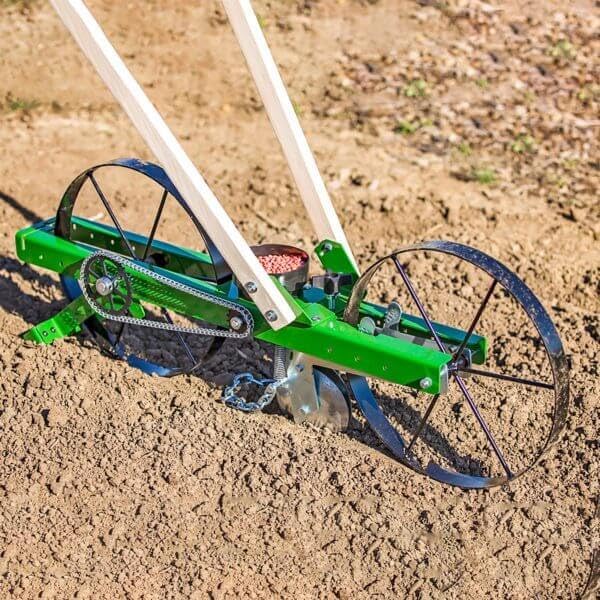
If you’ve ever tried to plant three 50-foot rows of carrots by hand — poking a finger into the soil every two inches for what feels like an eternity — you already understand the pitch for a walk-behind row seeder. These are push-along tools, roughly the size of a lawn edger, that open a small furrow in the soil, drop seeds at a set interval, cover them back up, and tamp the row closed, all in one pass. The spacing interval is controlled by a seed plate — a small interchangeable disc with pockets sized to pick up one seed at a time. Get the plate right for your seed size, and you can plant a 100-foot row of beets in under three minutes with consistent spacing that would take forty minutes by hand. The machines in this comparison range from about $100 to $565, and the differences between them are real enough to change whether a tool pays for itself in a single season — or collects dust in the shed.
This guide covers four machines that come up repeatedly in market-garden and serious home-grower conversations: the Hoss Garden Seeder, the Chapin 8701B, the Varomorus (Planet Jr.-style) seeder, and the Agri-Fab 45-0543. We’ll compare them on the axis that matters most — spacing accuracy — plus plate availability, build quality, and the break-even math for each tier.
How Spacing Accuracy Actually Works (and Where It Falls Apart)
Before comparing machines, it helps to understand the mechanism. A walk-behind seeder’s accuracy depends on three things working together: the seed plate picking up exactly one seed per pocket, the furrow opening at a consistent depth so seeds don’t bounce, and the drive wheel maintaining consistent ground contact so the plate turns at the right rate.
When any of those three fail, you get what growers call “doubles” (two seeds in one spot) and “skips” (gaps with no seed). Doubles waste expensive seed; skips mean patchy stands and lost yield.
ATTRA/NCAT, in their publication “Vegetable Transplanting and Direct Seeding for Small Farms” (National Sustainable Agriculture Information Service), notes that a skip rate below 8–10% is considered acceptable performance for a push seeder under real field conditions — compacted clay, slight grades, or end-of-row turns all degrade accuracy. Keep that benchmark in mind as you read the machine comparisons below.
Plate fit is the most underrated variable. A pocket that’s too large for your seed will pick up doubles; one that’s too small will tumble seeds back into the hopper. The Johnny’s Selected Seeds Seeder Comparison Chart, published in the 2025 johnnysseeds.com catalog, recommends verifying plate-to-seed diameter match within roughly 10% for reliable singulation — and this is where cheaper machines with smaller plate libraries create a hidden cost. The SARE publication “Sustainable Vegetable Production from Start-Up to Market” (Sustainable Agriculture Research and Education program) reinforces this point, noting that equipment mismatched to seed size is among the most common causes of poor stand establishment on small diversified farms.
The Four Machines: Specs, Strengths, and Honest Tradeoffs
Hoss Garden Seeder — ~$185–$215 (single-row)
The Hoss seeder has become the de facto mid-range benchmark in market-garden circles, and for understandable reasons. Hoss supplies 13 seed plates with the base unit covering everything from tiny carrot seed up to large corn, and sells additional plates individually. The cast-iron furrow opener and steel frame draw consistently favorable commentary from operators in long-run growing-season reviews — the consensus is that the machine holds up to several seasons of 40- to 60-bed production without the wobble that develops in lighter plastic-chassis alternatives.
Spacing accuracy reports documented in Growing for Market’s seeder coverage place the Hoss in a reliable range for medium to large seed — beans, beets, chard, squash — where plate pockets are well-matched. For very fine seed, such as raw carrot seed at roughly 1.5–2mm or pelleted lettuce, operators consistently note that proper hopper adjustment and walking-speed discipline matter more than on pricier vacuum machines. At a brisk pace or on rough ground, skip rates climb.
The Hoss row-marker attachment (roughly $30 as an add-on) is worth calling out separately: it scribes the next row line as you plant the current one, which meaningfully reduces layout time across a multi-bed plot.
Best for: Kitchen gardeners and market growers planting 500–3,000 row-feet per season in medium-to-large seed crops. The plate library and frame quality make this the clear value choice in the $180–220 range.
Tradeoff: Not ideal for fine seed at high throughput. If more than 30% of your planting is carrots or fine-pelleted greens, evaluate whether stepping up to a vacuum-singulation machine is worth the price difference.
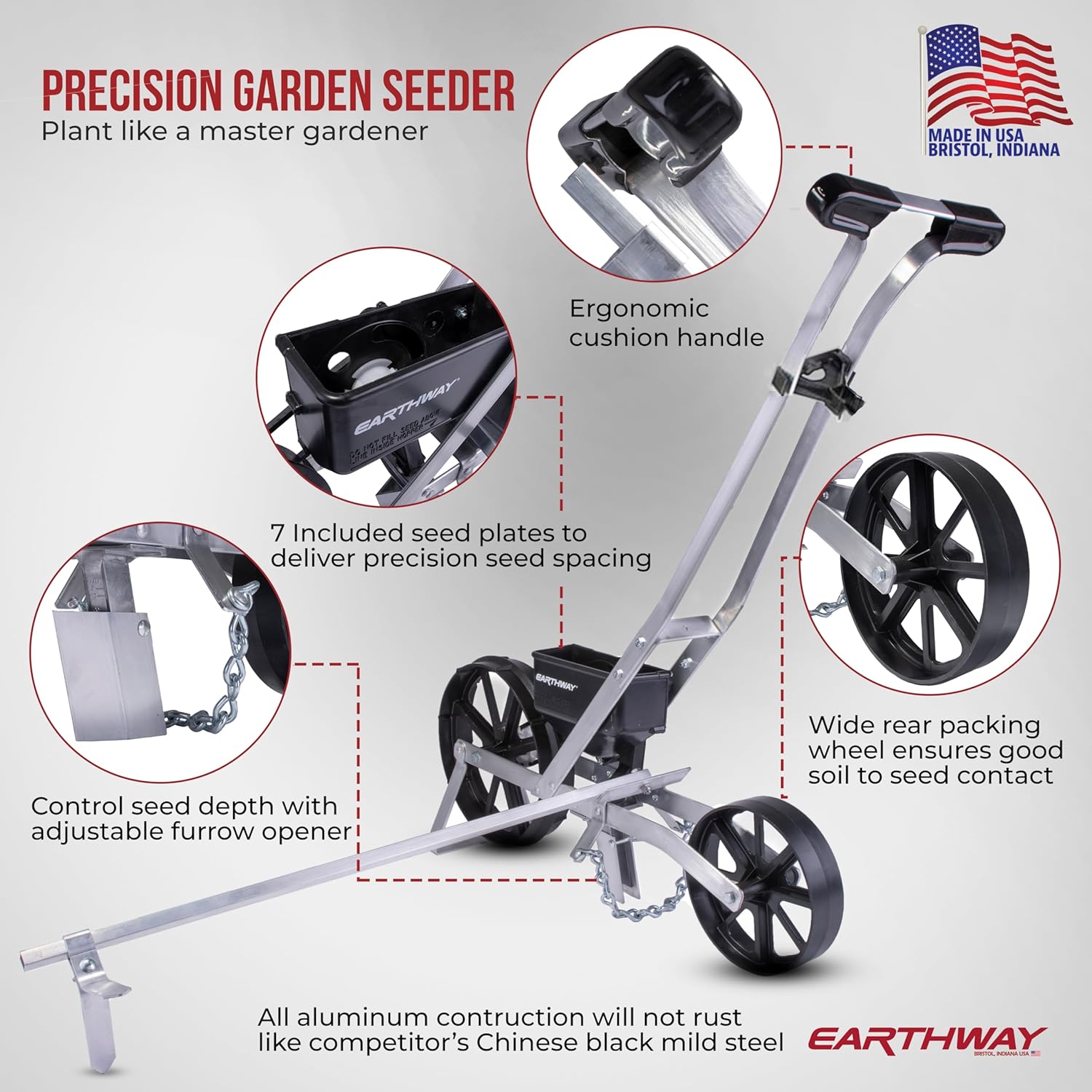
EarthWay
$136.99
In stock on Amazon
Check price on AmazonChapin 8701B Garden Seeder — ~$100–$130
The Chapin 8701B is the entry point of this comparison and, in a real sense, the entry point of the walk-behind category for many home growers. It ships with six seed plates, a plastic hopper, and a lighter steel frame than the Hoss. Operating weight comes in below 10 lbs, which is noticeable over a long planting session.
Across aggregated operator experience documented in the Johnny’s Selected Seeds catalog seeder notes (johnnysseeds.com, 2025), the pattern is consistent: the Chapin performs acceptably on medium-sized, round seed — beans, peas, beets, large-pelleted lettuce — where the included plates were designed to shine. Spacing accuracy in that seed range is reported as genuinely competitive with machines costing twice as much.
Where the Chapin earns its asterisk is durability and plate library depth. Operators working more than one or two seasons at market-garden volume report plastic hopper wear, furrow-opener flex on harder soils, and difficulty sourcing replacement plates through standard retail channels. The six included plates also leave gaps: if you grow a wide variety of crops including fine-seeded items, you’ll hit the limit of the available plate set quickly.
Best for: Weekend gardeners and first-season home growers who want to graduate from finger-sowing on a budget. Also a reasonable backup machine for a larger operation that needs a spare.
Tradeoff: The plate library limitation and lighter build make this a one-to-two season tool at serious production volume. At current pelleted-seed pricing — pelleted carrot seed runs roughly $18–$30 per thousand from major seed suppliers — even a modest improvement in germination efficiency from better plate fit can offset the cost difference between the Chapin and the Hoss within a single season for growers planting 2,000 or more row-feet.
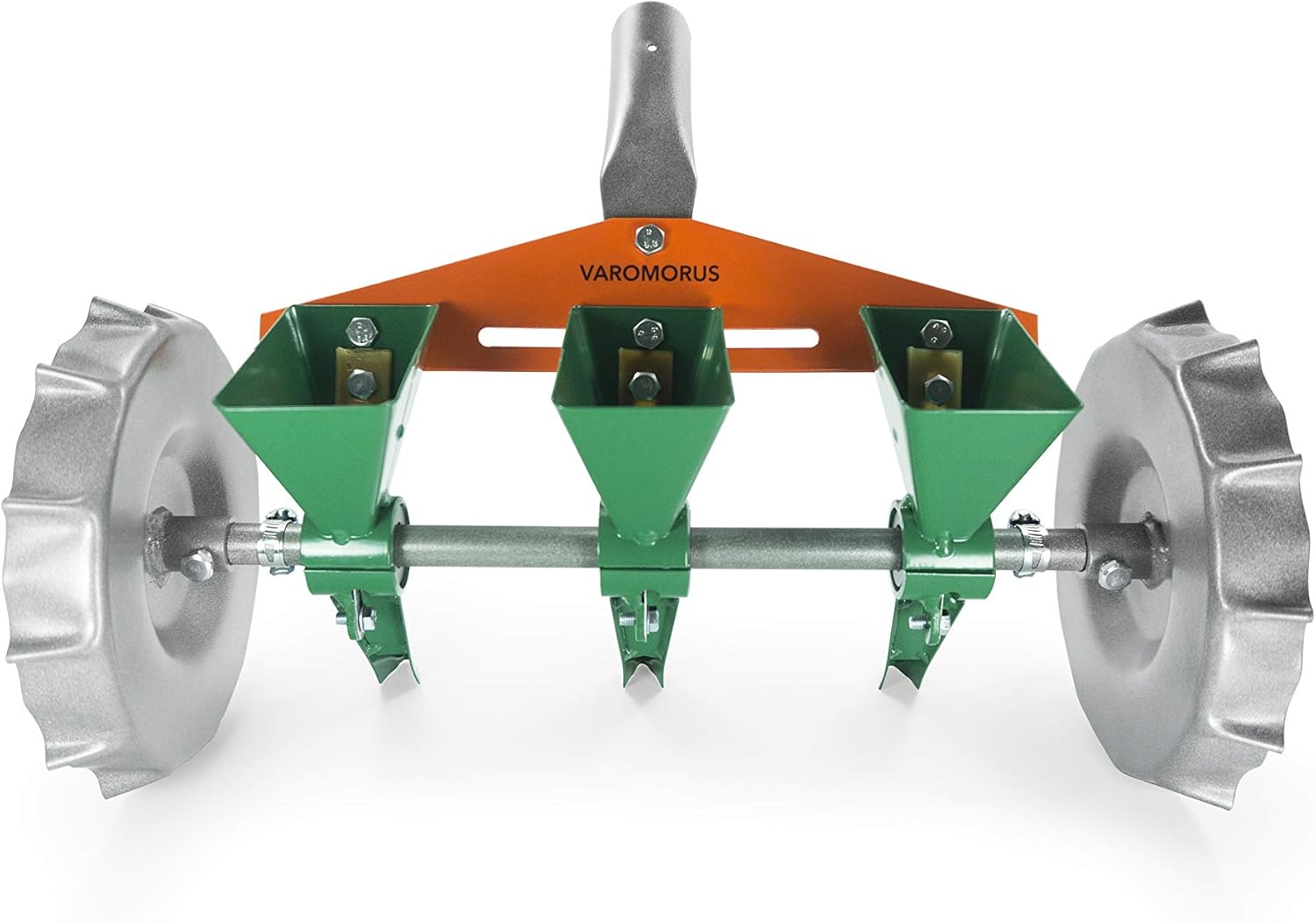
Varomorus
$114.95
In stock on Amazon
Check price on AmazonVaromorus / Planet Jr.-Style Seeder — ~$120–$160
The “Planet Jr.” design — named after the classic American garden seeder that has been produced in various forms since the 1890s — is sold today under several brand names including Varomorus and through generic-import channels in farm supply catalogs. These machines use an open-frame design with a large seed hopper and interchangeable plates that are, importantly, cross-compatible with a wide aftermarket.
The plate compatibility is the compelling argument. Because the Planet Jr. plate pattern functions as an open standard, operators can source plates from multiple suppliers, including aftermarket options sized for unusual crops that no single original-equipment manufacturer covers. The Rodale Institute’s “Small-Farm Seeding Equipment Overview,” available through the rodaleinstitute.org resource library, cites the Planet Jr. design’s longevity and part availability as a genuine operational advantage for diversified small farms — a point that remains relevant as long as aftermarket plate suppliers continue to support the format.
Spacing accuracy is reported as competitive with the Chapin in the medium-seed range, and operators note that the Planet Jr.’s plate geometry tends to handle non-spherical seed — flat squash seed, irregular bean varieties — more tolerantly than the Chapin’s plate pockets. However, the drive mechanism on Varomorus-label units specifically draws critical operator notes around wheel slip on loose or freshly tilled soil, which is precisely the condition you’re planting into. Skip rates increase meaningfully on sandy or very loose beds.
Best for: Diversified growers who want aftermarket plate flexibility and are willing to manage the wheel-slip limitation through slightly firmer bed preparation before planting.
Tradeoff: Quality control across Varomorus-label units is less consistent than Hoss. Inspect for frame weld quality and wheel bearing play before first use. The aftermarket plate advantage is real, but it requires research time to identify compatible suppliers for your specific crop list.
Varomorus
$114.95
In stock on Amazon
Check price on AmazonAgri-Fab 45-0543 — ~$460–$565
The Agri-Fab sits at a different scale entirely. This is a multi-row unit designed primarily for larger garden plots and light agricultural use — marketed for planting up to five rows simultaneously with adjustable row spacing. At this price point, you’re paying for throughput, not precision singulation.
The machine’s weight and width also make it less maneuverable in standard 30-inch raised beds; it’s designed for open-field 36-to-48-inch row spacing configurations. Row-to-row consistency across all five openers simultaneously is harder to maintain than single-row accuracy, particularly on uneven terrain.
ATTRA/NCAT’s “Vegetable Transplanting and Direct Seeding for Small Farms” (National Sustainable Agriculture Information Service) provides a useful framing here: for market gardens under about a half-acre in intensive bed production, multi-row throughput is rarely the binding operational constraint. Bed layout, transplant work, and harvest tend to bottleneck before seeding speed does. The Agri-Fab makes more economic sense for field-scale growers planting open rows of sweet corn, beans, or sunflowers across a quarter-acre or more in a single session.
At $465–$565, the Agri-Fab competes with the lower end of true professional belt seeders — machines like the Jang JP-1, which enters the market around $400–$450 with rollers included. For intensive raised-bed production, a precision single-row belt seeder will outperform the Agri-Fab on accuracy and deliver better documented long-term durability across the market-garden operator community.
Best for: Field-scale home growers or market gardeners with open-row plantings covering 10,000 or more row-feet per season in large-seeded crops such as field corn, beans, and sunflowers.
Tradeoff: If your production is concentrated in intensive raised beds, the multi-row format creates more handling difficulty than it resolves. Redirect the budget toward a precision single-row machine and a full roller or plate set tuned to your crop list. The accuracy and durability return is better supported by operator experience documented in Growing for Market’s equipment coverage.
Hoss
$409.99
In stock on Amazon
Check price on AmazonBy the Numbers
| Machine | Street Price (2026) | Plates Included | Min Viable Seed Size | Best Seed Range | Tier |
|---|---|---|---|---|---|
| Chapin 8701B | ~$110 | 6 | ~3mm (pelleted) | Beans, peas, beets | Varomorus — $114.95 |
| Varomorus/Planet Jr. | ~$140 | 7–9 | ~2.5mm | Beans, squash, mixed | Varomorus — $114.95 |
| Hoss Garden Seeder | ~$195 | 13 | ~1.8mm | Carrots through corn | EarthWay — $136.99 |
| Agri-Fab 45-0543 | ~$515 | 6 | ~4mm (corn/bean scale) | Field corn, beans, sunflower | Hoss — $409.99 |
The Decision Rule: Match Machine to Scale and Seed Type
The comparison resolves into a fairly clean decision tree once you know your production scale and primary crops.
If you’re planting under 1,500 row-feet per season in beans, beets, and peas: The Chapin 8701B at roughly $110 does the job. Don’t overspend on a machine your production volume doesn’t justify. Upgrade when you outgrow the plate library or when frame wear becomes apparent — typically after two to three seasons of regular use.
If you’re planting 1,500–5,000 row-feet across a mix of crops including carrots or fine seed: The Hoss at roughly $195 is the right machine. The 13-plate library and cast-iron opener justify the price difference over the Chapin within one season of pelleted-seed savings for most growers. As the Johnny’s Selected Seeds Seeder Comparison Chart (johnnysseeds.com, 2025 catalog) frames it, the plate selection is effectively part of the purchase — a wider library means fewer compromised stands from ill-fitting plates.
If crop diversity and aftermarket plate flexibility matter more than frame refinement: The Varomorus/Planet Jr. at roughly $140 earns serious consideration, particularly if you grow unusual varieties where standard plate libraries fall short. Budget for firm bed preparation to manage the wheel-slip limitation on loose soil.
If you’re planting open-field rows at quarter-acre-plus scale in large-seeded crops: The Agri-Fab’s multi-row throughput makes operational sense. But if your production is intensive raised-bed work, redirect those funds toward a precision belt or roller seeder and a full set of rollers matched to your crop list. The accuracy and durability return is better supported by operator experience documented in Growing for Market’s equipment coverage.
The walk-behind seeder category rewards clarity about actual production volume and seed types more than it rewards chasing the most expensive option. Match the plate to the seed, match the machine to the acreage, and consistent spacing accuracy tends to follow as a natural result.